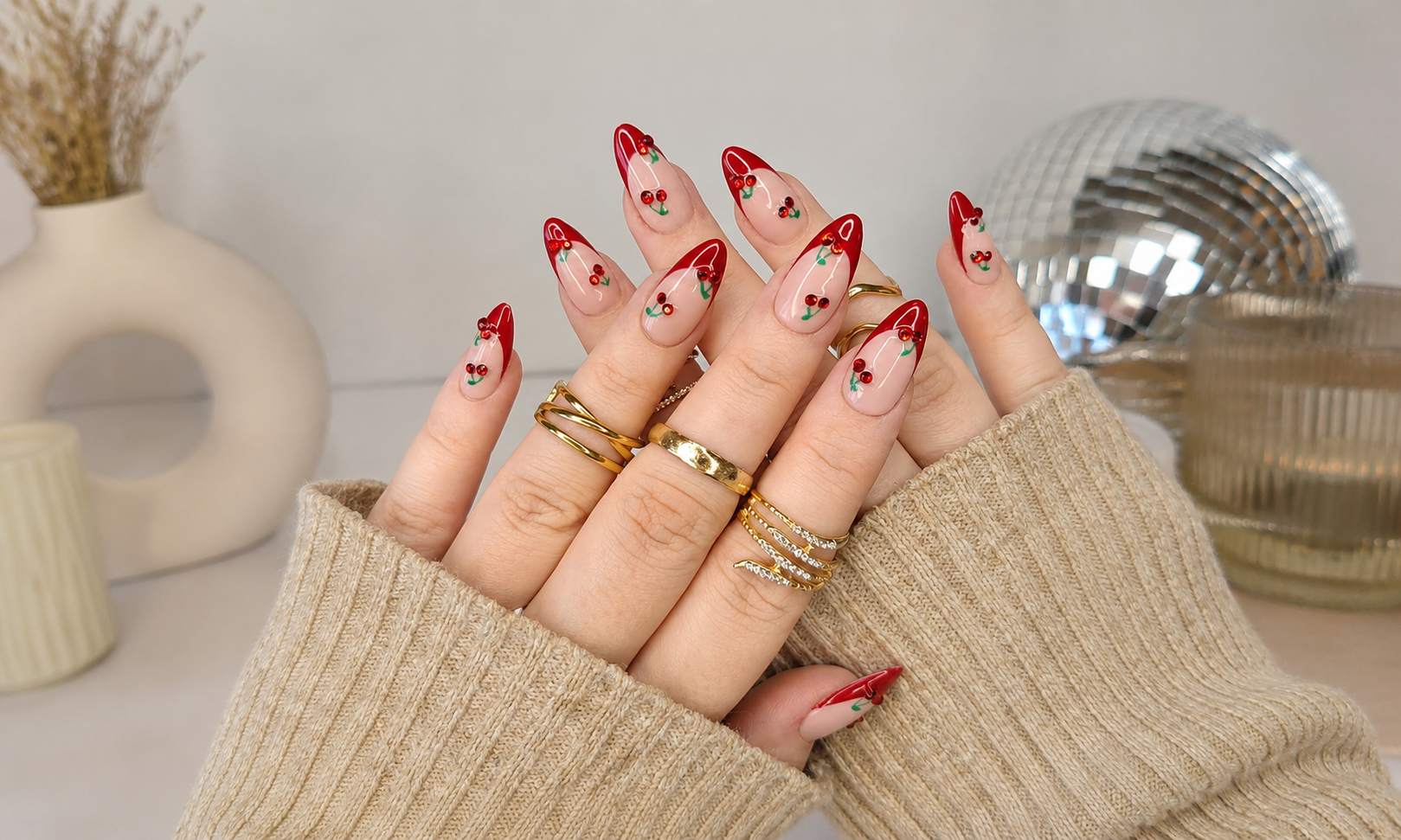
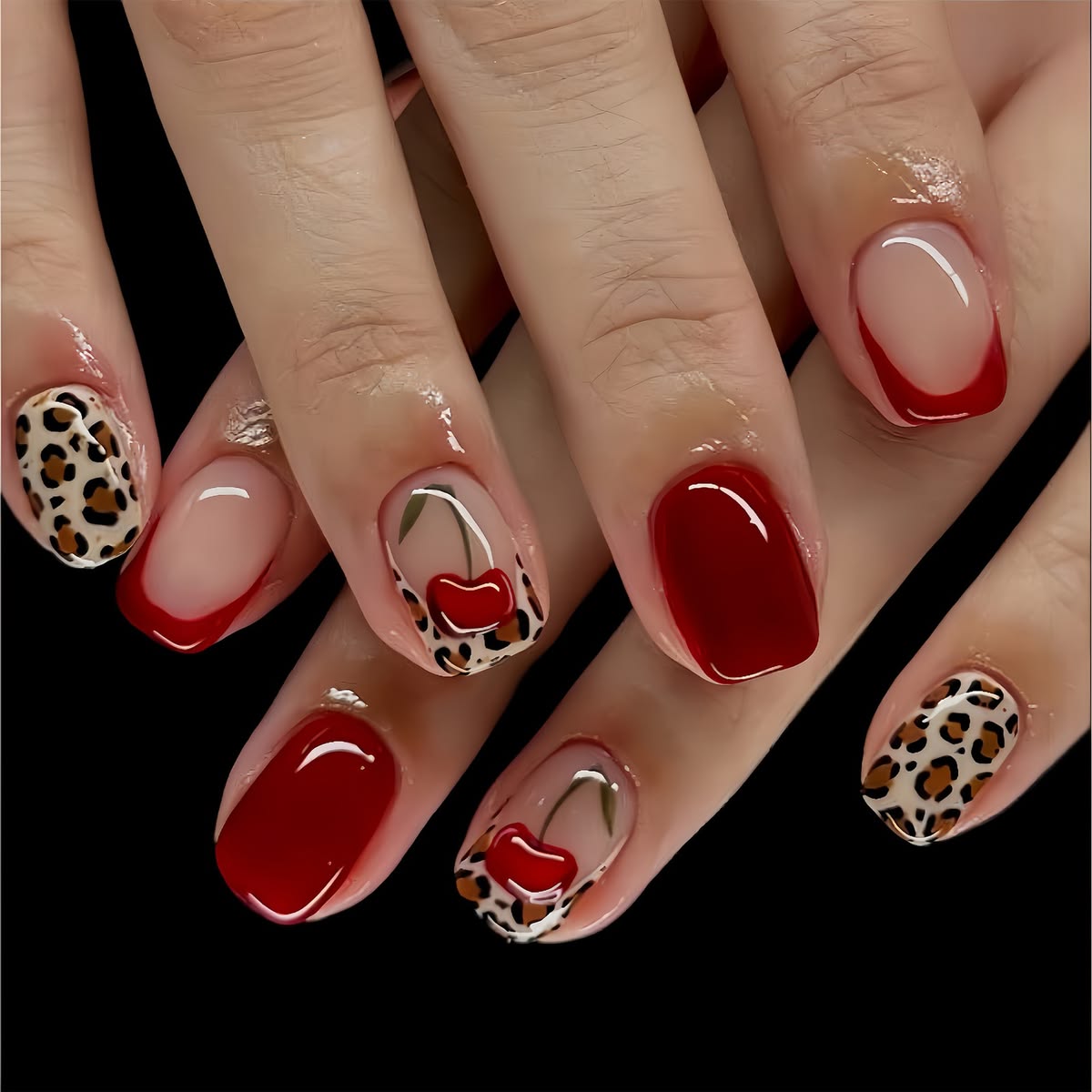
Almost every french tip that goes wrong goes wrong for the same reason: the tip was painted at a depth that suits a different nail. A 4 mm white tip is elegant on a long square nail and looks like the nail has been dipped in paint on a short round one. The colour was never the problem.
Shape decides two things, and both of them before you open a bottle. It decides how deep the tip should sit, which is a proportion rather than a fixed number, and it decides what the smile line should do — run straight across, follow a curve, or come to a point. Get those two right and a plain white tip looks salon-finished. Get them wrong and no amount of chrome or line art rescues it.
What follows is the same manicure worked across six shapes and lengths, with the depth and the line for each. If you already know your shape, skip to it. If you are choosing one, the table below is the short version.
- Tip depth is a proportion, not a measurement — roughly a fifth of the nail on short shapes, a third on long ones
- The smile line should echo the free edge. Straight edge, straight line. Curved edge, curved line. Pointed edge, angled line
- Dark tips need more depth than white at the same length, or they read as a chip
- On short nails, thinner is always safer. You can add depth at the next fill; you cannot take it back

What Nail Shape Suits French Tips Best?
Square and almond suit french tips best, because both give the smile line a clear edge to echo. Square produces the crispest, most graphic version; almond produces the softest and most flattering. Round and oval work well at short lengths with a thinner tip, and coffin works but needs the deepest tip of any shape to stay in proportion.
There is no shape a french tip cannot be worn on. What changes is the depth and the shape of the line, and those two adjustments are what this guide is for.
Tip depth and line shape by nail shape
| Shape | Tip depth | Smile line | Watch out for |
|---|---|---|---|
| Short square | 1.5–2 mm | Straight across | Depth. Anything over 2 mm shortens the nail |
| Long square | 3–4 mm | Straight, or a very shallow curve | Uneven line — a straight edge shows every wobble |
| Short round or oval | 1–1.5 mm | Curved, following the edge | Thick tips. This shape needs the thinnest line of all |
| Medium almond | 2.5–3 mm | Soft curve, deeper at the sidewalls | Little — this is the most forgiving shape |
| Long almond or stiletto | 4–6 mm | Angled, running toward the point | A flat line. It fights the taper of the nail |
| Coffin or ballerina | 4–5 mm | Straight, matching the flat tip | Under-filling. A shallow tip looks unfinished here |
1. Short Square

The most-worn nail shape and the least forgiving french tip. A short square nail has very little length to give away, so every extra half-millimetre of tip comes straight out of the visible nail. Keep it to 1.5 to 2 mm and run the line dead straight across, parallel to the free edge.
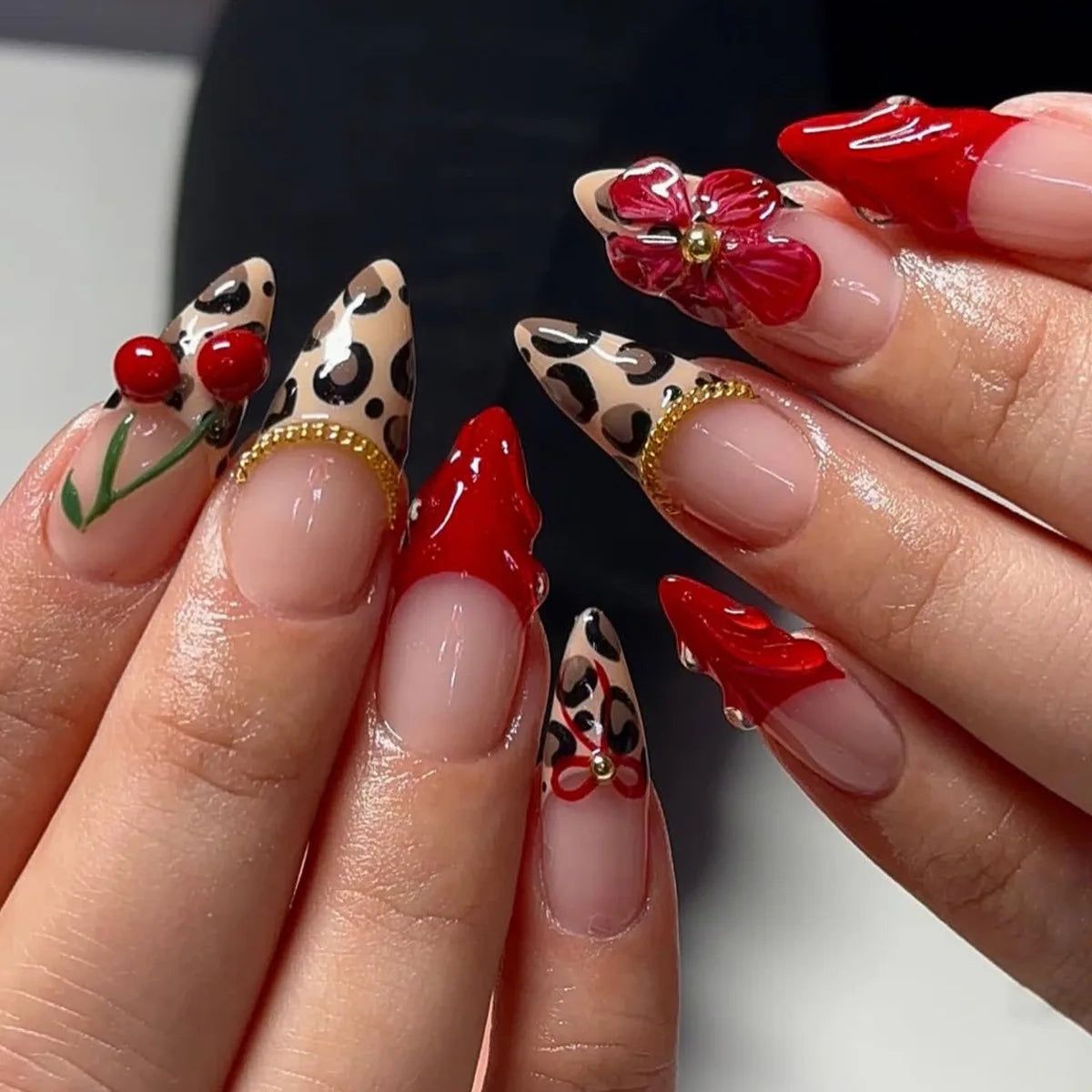
Because the tip is so thin, this is the shape where a small detail earns its place. The gold dots above sit along the smile line and add interest without adding depth — they read as a second line rather than a wider one, which is exactly what a short nail needs.
Take the tip slightly higher at the sidewalls than in the centre — by well under a millimetre. It is invisible as a decision and it stops a straight line looking like it is sliding off the nail.
Do not wear a dark tip at this length and depth. Black or deep brown needs 3 mm or more to register as a shape, and 3 mm on a short square nail leaves almost nothing showing.
2. Long Square

This is the shape the french manicure was built for. A long square nail gives you a flat free edge to run the line against and enough nail that a 3 to 4 mm tip still leaves plenty of base showing. It produces the crispest, most graphic version of the look.
The trade-off is that a straight line is unforgiving. Any wobble reads instantly, because the eye has the flat edge of the nail sitting right beside it as a reference. This is the one shape where taking the extra two minutes to correct the line with a cleanup brush genuinely changes the result.
Match the depth across all five nails to the shortest nail on the hand, not the longest. Tips set to the longest finger leave the little finger looking half-painted.
Avoid a deep curve on a square nail. A curved line under a flat edge leaves a crescent of base colour at each corner and makes the nail look badly filed rather than deliberately shaped.
3. Short Round and Oval

The shape most natural nails already are, and the one people assume cannot carry a french tip. It can — at 1 to 1.5 mm, which is thinner than most people think is worth doing. At that width the tip stops being a block of colour and becomes an outline, which is what suits a rounded edge.
The line has to follow the curve of the free edge exactly. On a round nail there is no straight reference anywhere, so a straight line across looks like a mistake rather than a style choice. Think of it as tracing the edge a millimetre inward rather than drawing a new line.
Use a liner brush rather than the polish brush. At this width the bottle brush holds more product than the line can take, and the tip ends up twice the depth you intended.
Do not use guide stickers on a round nail. They are cut for straight and curved-square edges, and on a round free edge they lift at the sidewalls and leak underneath.
4. Medium Almond

The most forgiving shape for a french tip and the reason it appears in more sets than any other. The taper of an almond nail already draws the eye down toward the tip, so the line has help. At 2.5 to 3 mm with a soft curve that sits deeper at the sidewalls than in the centre, it is very difficult to get wrong.
It is also the shape that takes a blurred edge best. The set above uses a soft ombre rather than a crisp line, sponged so the white fades into the base instead of stopping at it. On a square nail that softness reads as an unfinished line; on an almond it reads as a deliberate gradient, because there is no hard edge nearby to contradict it.
For the ombre version, sponge over a cured base rather than a wet one. The cured layer fills the texture the sponge leaves behind, which is what removes the speckled look that gives a home ombre away.
Do not run the line flat across an almond nail. The shape is symmetrical about its centre line, and a flat tip cuts against that symmetry in a way that makes the nail look shorter than it is.
5. Long Almond and Stiletto

Once the nail comes to a point, the tip has to change from a band into a wedge. A flat line across a pointed nail leaves a triangle of colour above it that has no relationship to the shape. Instead the line should run at an angle toward the point, deeper at the outer sidewall than the inner one, so the coloured area tapers the way the nail does.
Depth goes up to 4 to 6 mm here, which sounds like a lot and is not, because the nail is long enough to absorb it. This is also the only length where a full V-french — a line that meets in a point at the centre — works without looking like a costume.
Mirror the angle between the two hands rather than repeating it. Both hands angled the same way looks like one of them was done in a hurry.
Do not put art on every nail at this length. A long pointed nail already reads as a statement; decoration on all ten removes the plain nails that the decorated ones need in order to register.
6. Coffin and Ballerina
A coffin nail tapers like an almond but finishes flat, so it wants the depth of a long shape with the straight line of a square one. Run the tip straight across at 4 to 5 mm, matching the flat free edge exactly.
The mistake here is under-filling. Because the nail narrows toward the tip, a shallow band sits on the narrowest part and looks like it ran out rather than stopped. If the tip does not look slightly too deep while you are painting it, it is probably too shallow once the hand is at arm’s length.
Save the depth chart so it is there the next time you sit down with a liner brush.
Do French Tips Make Your Nails Look Longer?
A thin french tip makes nails look longer; a deep one makes them look shorter. The line acts as a visual full stop, so the higher up the nail it sits, the shorter the nail reads — regardless of how long it actually is.
That is why the depths in the table above are proportions rather than fixed numbers. Two millimetres on a long square nail is a fine hairline that lengthens the hand. The same two millimetres on a short round nail covers a fifth of the visible surface and shortens it. If lengthening the hand is the goal, go thinner than feels right and keep the base sheer, so there is no second line where the colour starts.
- 15 French Tip Nail Designs and How to Get Each One — once the shape is settled, the colours and art that go on it
- 14 Floral French Tip Nail Designs — flower placement across the smile line
- Brown French Tip Nails with White Flowers — how a dark tip changes the depth you need
What nail shape suits french tip nails best?
Square and almond. Square gives the crispest, most graphic result because the flat free edge gives the smile line a clear reference. Almond is the most forgiving, because the taper of the nail already pulls the eye toward the tip and a soft curve is harder to get visibly wrong.
Should the tip follow the nail shape or run straight across?
It should echo the free edge. Straight across on square and coffin, a soft curve on round, oval and almond, and an angle running toward the point on stiletto and long almond. A line that contradicts the edge it sits under is what makes a french tip look homemade.
Do french tips work on oval and round nails?
Yes, at 1 to 1.5 mm, painted with a liner brush rather than the bottle brush. At that width the tip reads as an outline tracing the free edge rather than a band of colour, which is what suits a rounded shape. Guide stickers do not work on this shape because they are cut for straight edges.
Are french tips better on almond or coffin nails?
Almond is easier and suits more hands; coffin makes the stronger statement. Almond takes a soft curved line at 2.5 to 3 mm, while coffin needs a straight line at 4 to 5 mm because it finishes flat and tapers, so a shallow tip on a coffin nail looks unfinished.
How does tip depth change with nail length?
Roughly a fifth of the visible nail on short shapes and up to a third on long ones. In millimetres that runs from about 1 mm on a short round nail to 6 mm on a long stiletto. Set the depth by proportion, not by copying a number from a photo of a different nail.
Does a dark tip need to be deeper than a white one?
Yes, by about a millimetre at the same length. A dark colour at 1 to 2 mm reads as a chip or a shadow rather than a deliberate shape, which is why black and deep brown tips suit medium and long nails and rarely work on short round ones.
Where to Start
Find your shape in the table, take the lower number in its range, and paint a plain white tip on one nail. Look at that hand at arm’s length rather than up close — the depth that looks timid at reading distance is usually correct at conversation distance.
Once the depth and the line are right for your hand, the colour is the easy part, and it is the only part you can change without redoing the whole set.